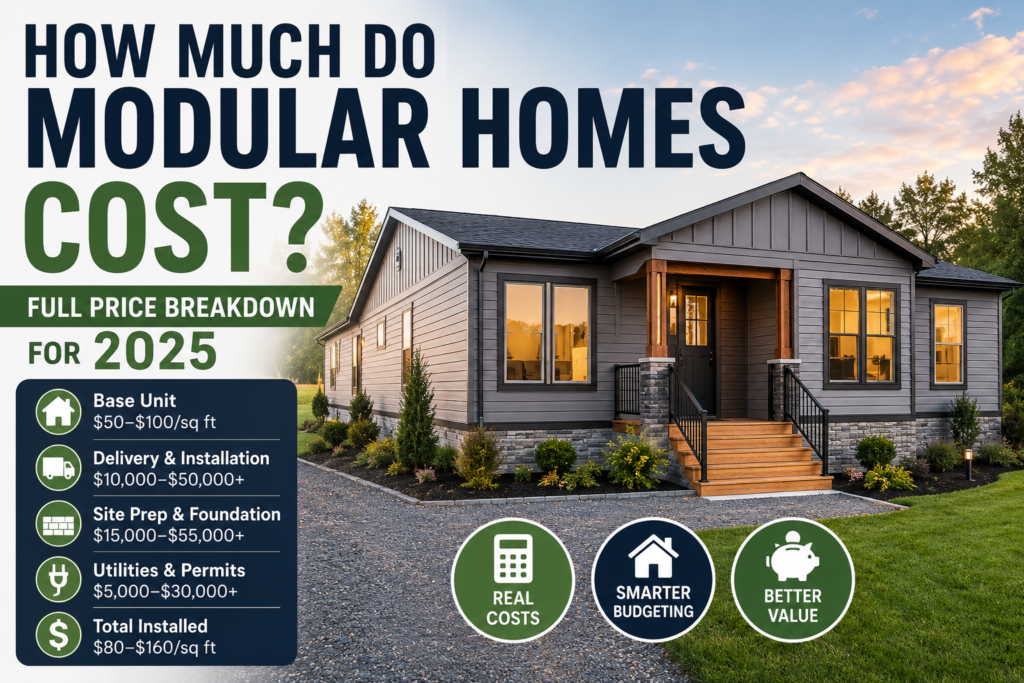

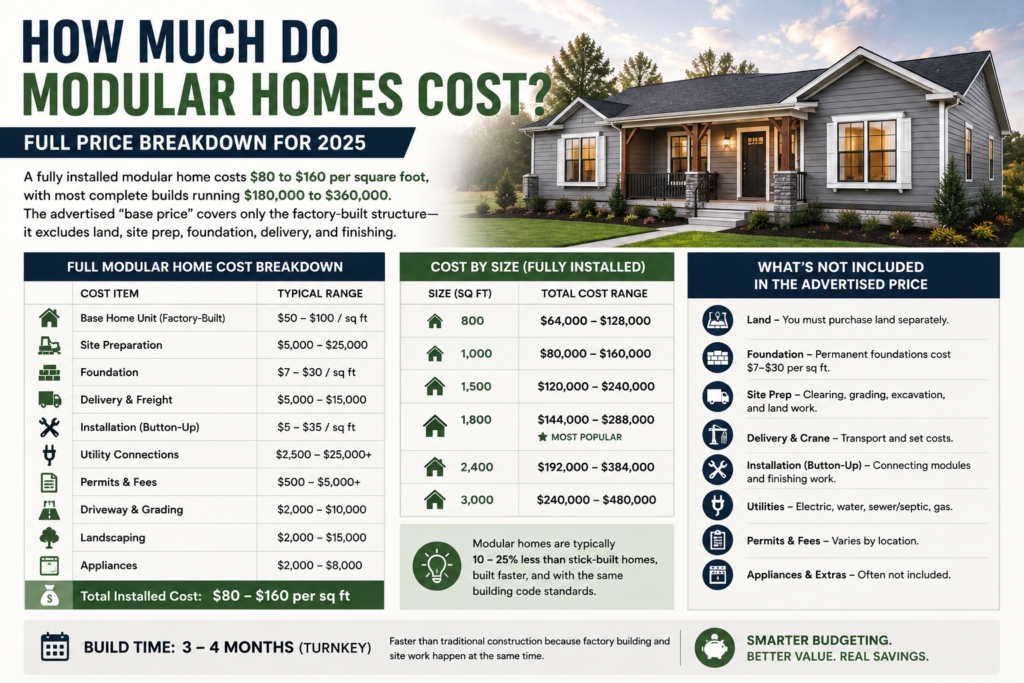
Quick Answer: A fully installed modular home costs $80 to $160 per square foot, with most complete builds running $180,000 to $360,000. The average is around $270,000. The advertised “base price” covers only the factory-built structure — it excludes land, site prep, foundation, delivery, and finishing, which together can add $50,000 to $150,000 or more.
Modular homes are one of the most Googled housing options right now, and it’s easy to see why: manufacturers advertise prices that look dramatically lower than anything you’d find in a traditional new-build market. But those numbers can mislead buyers who don’t know what they’re looking at.
The base price covers the factory-built structure and little else. By the time you add the land, foundation, site preparation, delivery, utility hookups, and finishing work, the total is a very different number. This guide breaks down every cost involved so you know exactly what to budget — and why modular homes can still be a genuinely smart financial choice when you understand the full picture.
What Does a Modular Home Cost Per Square Foot?
There are two prices you’ll encounter when researching modular homes, and they describe two very different things.
Base unit cost: $50–$100 per square foot. This is what manufacturers and dealers advertise. It covers the factory-built sections (modules) of the home, delivered to your site. It does not include land, foundation, delivery crane, installation labor, utilities, or permits.
Total installed cost: $80–$160 per square foot. This is what you’ll actually spend to have a finished, livable home. It includes everything from site preparation through the finishing touches that make the home move-in ready.
On an 1,800-square-foot home — a common three-bedroom size — the base unit might cost $90,000 to $180,000, while the total project lands between $144,000 and $288,000. The gap between those numbers is real and consistent across the industry.
Modular Home Cost by Size
| Size | Base Unit Only | Fully Installed | Typical Use |
| 800 sq ft | $40,000–$80,000 | $64,000–$128,000 | Tiny/studio |
| 1,000 sq ft | $50,000–$100,000 | $80,000–$160,000 | 1–2 bed starter |
| 1,500 sq ft | $75,000–$150,000 | $120,000–$240,000 | 3 bed ranch |
| 1,800 sq ft | $90,000–$180,000 | $144,000–$288,000 | 3–4 bed average |
| 2,400 sq ft | $120,000–$240,000 | $192,000–$384,000 | 4 bed family |
| 3,000 sq ft | $150,000–$300,000 | $240,000–$480,000 | Large/custom |
Note: These ranges reflect standard floor plans with mid-grade finishes. Custom layouts, premium materials, difficult site access, or high-cost-of-living regions can push totals significantly above the upper end.
Full Modular Home Cost Breakdown
Here is every line item that goes into a complete modular home project. Most buyers who feel surprised by their final cost simply weren’t shown this list upfront.
| Cost Item | Range | Notes |
| Base home unit | $50–$100/sq ft | The factory-built structure only |
| Site preparation | $5,000–$25,000 | Land clearing, grading, excavation |
| Foundation | $7–$30/sq ft | Varies by type (slab, crawl space, basement) |
| Delivery & freight | $5,000–$15,000 | Transportation + crane rental |
| Installation (button-up) | $5–$35/sq ft | Connecting modules, sealing, finishing |
| Utility connections | $2,500–$25,000+ | Electric, water, sewer/septic, gas |
| Permits & fees | $500–$5,000 | Varies significantly by state/county |
| Driveway & grading | $2,000–$10,000 | Access road to the home site |
| Landscaping | $2,000–$15,000 | Optional; not included in most quotes |
| Appliances | $2,000–$8,000 | Often not included in base price |
The base unit typically represents 50 to 60 percent of the total project cost. The remaining 40 to 50 percent covers everything that turns a delivered structure into a functioning home on your land.
What’s Not Included in the Advertised Price
This is the most important section for first-time modular home buyers. When a manufacturer or dealer quotes you a price, read the fine print carefully. Most base quotes exclude:
Land. You need a plot of land before any home can be delivered. Land costs vary enormously — from $5,000 in rural areas to $200,000+ in suburban or coastal markets. This is entirely separate from the home cost.
Foundation. Modular homes sit on permanent foundations, which cost $7 to $30 per square foot. A slab foundation on a 1,500-square-foot home runs $10,500 to $45,000. Basements and crawl spaces cost more.
Site preparation. Land clearing, tree removal, grading, and excavation run $5,000 to $25,000 depending on your lot’s condition. Flat, clear land costs far less than wooded or uneven terrain.
Delivery and crane rental. Modules are transported by truck and lifted onto the foundation by crane. Expect $5,000 to $15,000 for freight and crane costs, more for remote locations or difficult access.
Button-up labor. After modules are placed on the foundation, a crew connects them, seals the seams, and completes all interior and exterior finish work. This costs $5 to $35 per square foot.
Utility connections. Running electric, water, gas, and sewer or septic lines to the home costs $2,500 to $25,000 or more, depending on how far the home sits from existing infrastructure.
Permits and inspections. Permit fees vary by state and county, ranging from $500 to $5,000+. Some areas charge a percentage of the total project value.
Appliances. Modular homes are often delivered without appliances. Budget $2,000 to $8,000 for a full set.
Pro tip: Always ask for a “turnkey” or “total installed” quote, not just the base or “base model” price. A reputable dealer will give you a full project estimate including all site work, delivery, and finishing costs.
Modular Home Cost by Bedroom Count
If you’re budgeting by bedroom count rather than square footage, here are realistic total installed cost ranges for standard floor plans:
1-bedroom (600–900 sq ft): $48,000–$144,000 total. Typically used as guest houses, starter homes, or accessory dwelling units (ADUs).
2-bedroom (900–1,200 sq ft): $72,000–$192,000 total. Entry-level family homes or downsizing options.
3-bedroom (1,400–1,800 sq ft): $112,000–$288,000 total. The most popular category, representing the average modular home build.
4-bedroom (2,000–2,500 sq ft): $160,000–$400,000 total. Family homes with room to grow; pricing depends heavily on finishes and location.
5+ bedrooms or custom designs (2,500+ sq ft): $200,000–$600,000+. Larger modular builds command premium prices but still typically undercut equivalent stick-built homes.
Modular vs. Stick-Built Cost Comparison
One of the main reasons buyers consider modular construction is cost savings over traditional site-built homes. Here’s how they compare:
| Factor | Modular Home | Stick-Built Home |
| Cost per sq ft (complete) | $80–$160 | $150–$250 |
| Average 1,800 sq ft total | $144K–$288K | $270K–$450K |
| Build time | 3–4 months | 5–7 months |
| Weather delays | Minimal (factory build) | Common |
| Customization flexibility | Moderate | High |
| Financing | Construction loan → mortgage | Construction loan → mortgage |
| Appraises as real property? | Yes (on permanent foundation) | Yes |
| Typical savings vs. stick-built | 10–25% less | Baseline |
Modular homes are generally 10 to 25 percent cheaper than equivalent stick-built homes. The savings come primarily from factory efficiency: standardized assembly lines, bulk material purchasing, less waste, and labor that isn’t subject to weather delays or subcontractor scheduling issues.
That said, the savings can shrink or disappear in specific scenarios. If your land requires significant preparation, is in a remote location with difficult truck or crane access, or if you choose heavy customization, your total cost can approach what you’d spend on traditional construction.
Important: Modular homes are not the same as manufactured or mobile homes. Modular homes are built to the same state and local building codes as site-built homes, sit on permanent foundations, and are classified as real property — meaning they qualify for conventional mortgages and appreciate in value like any standard home.
Factors That Affect the Final Price
Two modular homes with the same advertised base price can end up $100,000 apart in total cost. Here’s what drives the spread:
Location
Your state and county affect nearly every cost in the project: labor rates, permit fees, foundation requirements, and material availability. A home built in rural Tennessee will cost substantially less than the same model in coastal California or the Northeast. Regional cost differences of $60,000 or more on the same build are common.
Site conditions
Flat, clear, easily accessible land with existing utility connections is the cheapest scenario. Add trees to remove, rocky or uneven terrain to excavate, or a long private road to build, and site prep costs climb fast. Remote lots that require utility lines to be run from a distance can add $20,000 to $50,000 alone.
Foundation type
A basic concrete slab is the least expensive option. A crawl space adds $5,000 to $15,000. A full basement is the most expensive foundation type at $20,000 to $100,000+ depending on size, but it adds livable square footage that can justify the cost.
Customization level
Standard floor plans with mid-grade finishes keep costs predictable. Each customization — modified layout, upgraded kitchen, premium flooring, expanded windows, energy-efficient systems — adds to both the base price and the installation time. Custom designs can add $12 to $160 per square foot to the base cost.
Home size and number of modules
Larger homes require more modules, more delivery trucks, more crane time, and more button-up labor. Delivery and installation costs don’t scale linearly with square footage, but they do increase.
How to Finance a Modular Home
Modular homes qualify for the same loan types as traditional homes, but the financing process works slightly differently because of the construction timeline.
Construction loan
Most modular home builds start with a construction loan, which funds the project in stages as work is completed. These loans typically require a 20 to 25 percent down payment and carry higher interest rates than permanent mortgages. Once construction is complete and the home is set on its permanent foundation, the construction loan is converted to a standard mortgage.
One-time close loans
Some lenders offer “one-time close” or “construction-to-permanent” loans that combine both the construction phase and permanent mortgage into a single loan with one closing. This simplifies the process and locks in your rate upfront.
Conventional and government-backed mortgages
Once a modular home is permanently installed on its foundation, it qualifies for conventional 30- or 15-year mortgages as well as FHA, VA, and USDA loans. The key requirement is that the home must be on a permanent foundation and titled as real property, not personal property.
Pro tip: Modular construction often takes 3 to 4 months from order to move-in, which is 2 to 3 months faster than stick-built construction. That shorter construction window means less time paying interest on a construction loan, which is a real cost savings that most comparisons don’t account for.
Frequently Asked Questions
How much does a modular home cost per square foot?
The base unit alone runs $50 to $100 per square foot. A fully installed, move-in-ready modular home costs $80 to $160 per square foot. The difference covers site prep, foundation, delivery, installation labor, and utility connections. For an 1,800-square-foot home, that’s roughly $90,000 to $180,000 for the unit and $144,000 to $288,000 all-in.
What is the average total cost of a modular home?
Most complete modular home projects cost $180,000 to $360,000, with a national average around $270,000. Very small or basic builds in low-cost areas can start near $40,000. Large custom builds in high-cost markets can exceed $775,000. The number in the middle — a 3-bedroom, 1,500-to-1,800-square-foot home with standard finishes — lands between $200,000 and $300,000 in most U.S. markets.
Are modular homes cheaper than stick-built homes?
Yes, typically 10 to 25 percent cheaper for a comparable home. Factory construction reduces labor hours, material waste, and weather-related delays. That said, site-specific factors like remote location, difficult terrain, or custom features can narrow or eliminate the savings. Do a full project comparison — not just base price — before assuming the modular option will be cheaper for your specific situation.
What is not included in the advertised modular home price?
The advertised base price usually covers only the factory-built structure. It excludes land, site preparation, foundation, delivery and crane rental, button-up installation labor, utility connections, permits and fees, driveway construction, landscaping, and appliances. These excluded items typically add $50,000 to $150,000 to the final project cost.
How long does it take to build a modular home?
A turnkey modular home project takes 3 to 4 months from order placement to move-in. Factory construction and site preparation (foundation, utilities) happen simultaneously, which saves significant time compared to stick-built construction. Traditional site-built homes average 5 to 7 months. The faster timeline means less time paying construction loan interest, which reduces overall financing costs.
Can you get a mortgage on a modular home?
Yes. Modular homes on permanent foundations qualify for conventional mortgages, FHA loans, VA loans, and USDA loans, exactly like site-built homes. During construction, you use a construction loan. Once the home is permanently set and titled as real property, it converts to a standard mortgage. Manufactured (mobile) homes have different financing requirements; modular and manufactured are distinct categories.
The Bottom Line
Modular homes offer real value, but only if you understand what you’re budgeting for. The base price that gets advertised is one component of a larger project. A complete, livable modular home will cost $80 to $160 per square foot once everything is included — land prep, foundation, delivery, finishing, and utilities.
For most buyers, the total investment falls between $180,000 and $360,000. That’s 10 to 25 percent less than a comparable stick-built home, built faster, with the same building code compliance and the same mortgage options.
The key is to get a full project quote, not just a base unit price. Ask any dealer or manufacturer to break out every cost from site prep through final finishing. If they can’t or won’t, find one who will.